
多通道火箭发射器 -Multi Rocket Launcher
Description
This launch controller can be used with low voltage battery igniters, which fire rocket engines in model rockets such as the Estes range. These circuits are electrical, only switches and contacts are involved. First the circuit for a single rocket:
The only thing to note here is that this controller uses "C" cells, providing more current than "AA" batteries and that the push button switch has contacts rated 1 amp or higher. The wire to the igniter is isolated via a 3.5 inch jack plug and socket. Connect the igniter, then plug in to control box and then press button, making sure you are the recommended distance away. Below is an internal and external picture of my controller:-
Ok, does anyone think my grass needs cutting? Moving on to the multi launch controller:-
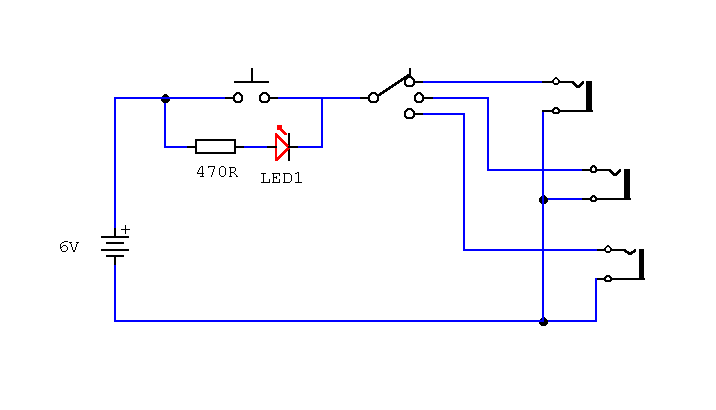
Mission Critical:
Heres a story about my own Estes space shuttle, on its one and only mission. This is what happens when you're too eager to get a rocket flying and don't pay attention to balance. It was a late November afternoon in 1998 when I first launched the shuttle. Lift off was perfect, no wind, clear skies (doesn't sound at all like England), and the rocket motor was a C6-5. At launch, the rocket motor fired, though lift off acceleration was not as good as I expected, I blame too much paint and excess weight). As my rocket reached apogee, (estimated height about 100 meters) and acceleration became zero there was no immediate separation between the shuttle and main fuel tank. There was of course a delay of 5 seconds between the rocket engine blowing its ejection charge. Five seconds is a long time too wait, especially when the forces excerted of gravity take hold. At 9.8 meters/second, the rocket plunged towards earth losing at least half its height. Then, thankfully the ejection charge blew, separation was achieved the the main fuel tank with SRB's drifted slowly down to earth on its parachute. However all was not well with the shuttle. It was only after separation that I realized there was too much nose weight (hence a heavy lift up and not enough height). The shuttle did glide, but only at about 45 degrees downward, picking up speed until eventually it crash landed in some soft mud. Luckily it survived the impact, I cleaned it up but have not yet removed the nose cone to balance the shuttle. I like it as an ornament anyway.
相关热词:#Multi
 函数发生器、信号发生器和波形发生器的区别
时间:2026-06-06
电子元器件的常见封装 各种封装类型的特点介...
时间:2026-06-06
 普通光敏二极管的检测
时间:2026-06-06
详细介绍8种常用的排序算法
时间:2026-06-06
 s9013三级管引脚图及参数
时间:2026-06-06
电压跟随器有什么作用?
时间:2026-06-06
VRRP是什么?VRRP的作用和工作原理
时间:2026-06-05
 32768晶振封装尺寸详解
时间:2026-06-05
静态路由是什么?静态路由如何配置?
时间:2026-06-05
一文详解光耦的作用与分类、使用技巧
时间:2026-06-05
 详解RCD钳位电路
时间:2026-03-08
三相异步电动机的拆装详讲
时间:2026-03-04
 基于逻辑门的构成解释如何完成任意逻辑的管...
时间:2026-03-08
三相异步电动机原理
时间:2026-03-04
 彩灯电路
彩灯电路
时间:2026-03-05
 NE555的有趣电路设计分享
时间:2026-03-08
 从0学电路,万用表演示测量三极管方法
时间:2026-03-08
 光耦在电子电路中作用、关键参数详解
时间:2026-03-08
 美的电磁炉电路图大全(六款美的电磁炉电路...
时间:2026-03-07
 H桥电机驱动电路解析
时间:2026-03-08