
击落模型定位器电路 (Downed Model Locator II)
Here is another device to help you locate your downed R/C sailplane in the bushes and weeds. Similar to the other design, this circuit plugs into a spare servo socket on your receiver, and it is a pulse omission detector. The alarm sounds when pulses originating from your transmitter are no longer being received--turn off your transmitter to turn on the alarm and help you find your plane. This circuit is simpler than the other design, is much easier to build, but is not quite as specific. While the other design tests for a specific frequency of pulses, this design is less picky, and may not work quite as well in areas with more radio frequency background noise. This design was originally collected from another web site, but the site has gone off-line and I'm unable to give proper credit to the individual. I modified the original design a little to make it work more reliably with the more aggressive automatic gain control of some of the current receivers.
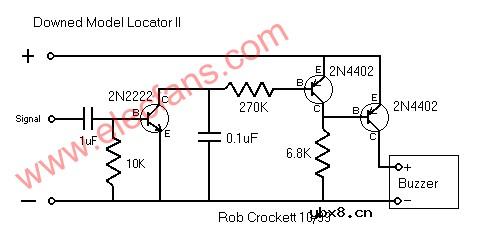
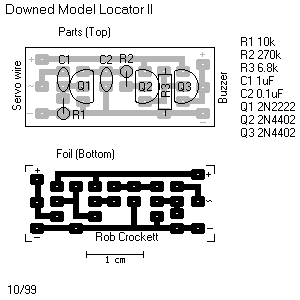
The circuit draws 1mA (!) when idle and 7 when buzzing. You can use a piezo buzzer right on the board (light and compact), a large piezo buzzer on a short wires (louder and easier to hear tone), or use the magnetic buzzer (a little heavier but good raspy sound). With the transmitter off, the alarm is mostly on, punctuated now and then by a servo wiggle and alarm silence from background radiofrequency noise pulses. This device is easy to build and works great. It's amazing how much your search time will be cut even with wind or surf noise in the background. Being able to hear it from 20 feet away often makes the difference between finding and not finding a plane.
If your plane went down because of radio interference, this device may not sound much. If you think it may have been interference from another pilot's transmitter on your frequency, be sure to have the other transmitter turned off before you go hunting for your plane.
The circuit uses your receiver battery for power. For the ultimate in reliability, you can use an additional battery to supply the alarm as follows. Connect only signal and negative leads to your receiver socket, and connect the second battery positive to positive circuit lead and negative to negative circuit lead. You will need to put some kind of switch in series with the second battery to keep it from running the alarm when you are not flying. With the extra battery, you will still be able to find your plane if your plane went down because of a receiver battery failure, or if your receiver battery fell out in the crash. Note: Do NOT solder to a button battery--they explode.
Here are few Radio Shack parts numbers. Please note that any type of capacitor will work (ceramic, electrolytic, etc.) but that the tantalum and monolithic capacitors are very small. The tantalum capacitors are polarized, but at these low voltages, the polarity probably does not matter.
| 273-074 | board mount tiny 12 volt piezo buzzer, one per | $2.99 | ||
| 273-065 | larger and louder 12 volt piezo buzzer, one per | $2.99 | ||
| 273-054 | 6 volt electromagnetic buzzer, one per | $2.59 | ||
| 276-1617 | 2N2222-type NPN switching transistors (box of 15) | $2.29 | ||
| 276-2023 | 2N4402-type PNP transistor (MPS2907), one per | $0.59 | ||
| 272-109 | 0.1uF monolithic capacitors, five per | $1.89 | ||
| 272-1434 | 1uF tantalum capacitor | $0.59 | ||
| 271-312 | 1/4 watt resistor assortment, 100 pieces | $7.99 |
相关热词:#定位器
 函数发生器、信号发生器和波形发生器的区别
时间:2026-06-06
电子元器件的常见封装 各种封装类型的特点介...
时间:2026-06-06
 普通光敏二极管的检测
时间:2026-06-06
详细介绍8种常用的排序算法
时间:2026-06-06
 s9013三级管引脚图及参数
时间:2026-06-06
电压跟随器有什么作用?
时间:2026-06-06
VRRP是什么?VRRP的作用和工作原理
时间:2026-06-05
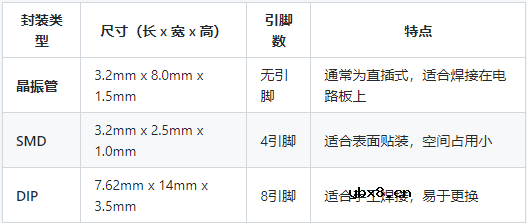 32768晶振封装尺寸详解
时间:2026-06-05
静态路由是什么?静态路由如何配置?
时间:2026-06-05
一文详解光耦的作用与分类、使用技巧
时间:2026-06-05
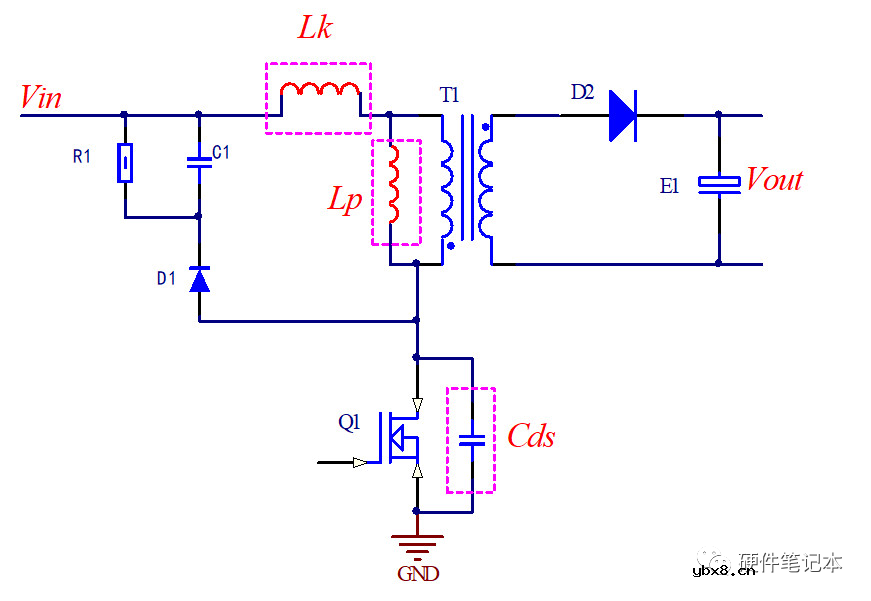 详解RCD钳位电路
时间:2026-03-08
三相异步电动机的拆装详讲
时间:2026-03-04
 基于逻辑门的构成解释如何完成任意逻辑的管...
时间:2026-03-08
三相异步电动机原理
时间:2026-03-04
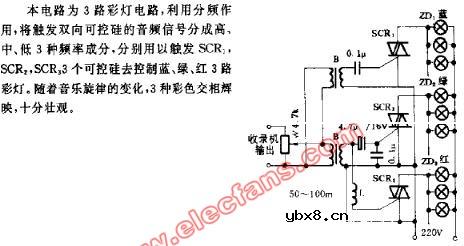 彩灯电路
彩灯电路
时间:2026-03-05
 NE555的有趣电路设计分享
时间:2026-03-08
 从0学电路,万用表演示测量三极管方法
时间:2026-03-08
 光耦在电子电路中作用、关键参数详解
时间:2026-03-08
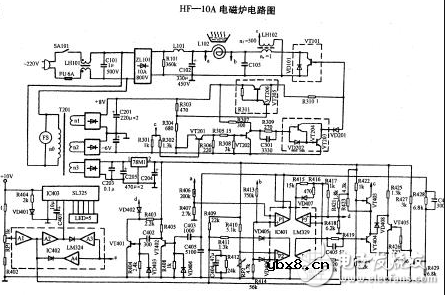 美的电磁炉电路图大全(六款美的电磁炉电路...
时间:2026-03-07
 H桥电机驱动电路解析
时间:2026-03-08